

Why Trust Signals and Authoritative Signals Matter for SEO Rankings.
Improving your website’s Google ranking isn’t about tweaking a few keywords or publishing more content—it’s about understanding why your site isn’t performing in the first place. Most websites struggle in search due to a combination of technical issues, weak or unfocused content, poor structure, and—most importantly—a lack of authority and trust signals. Until those problems are addressed together, rankings tend to stall, and conversions fall short.
At the same time, your visitors are making their own split-second judgments. Within seconds of landing on your site, they’re asking:
“Can I trust this business?”
If your website doesn’t immediately answer that question, users leave—and Google notices.
Don’t have time to read the full post? Scroll to the FAQs at the end for a quick breakdown.
What Google Looks for: E-E-A-T
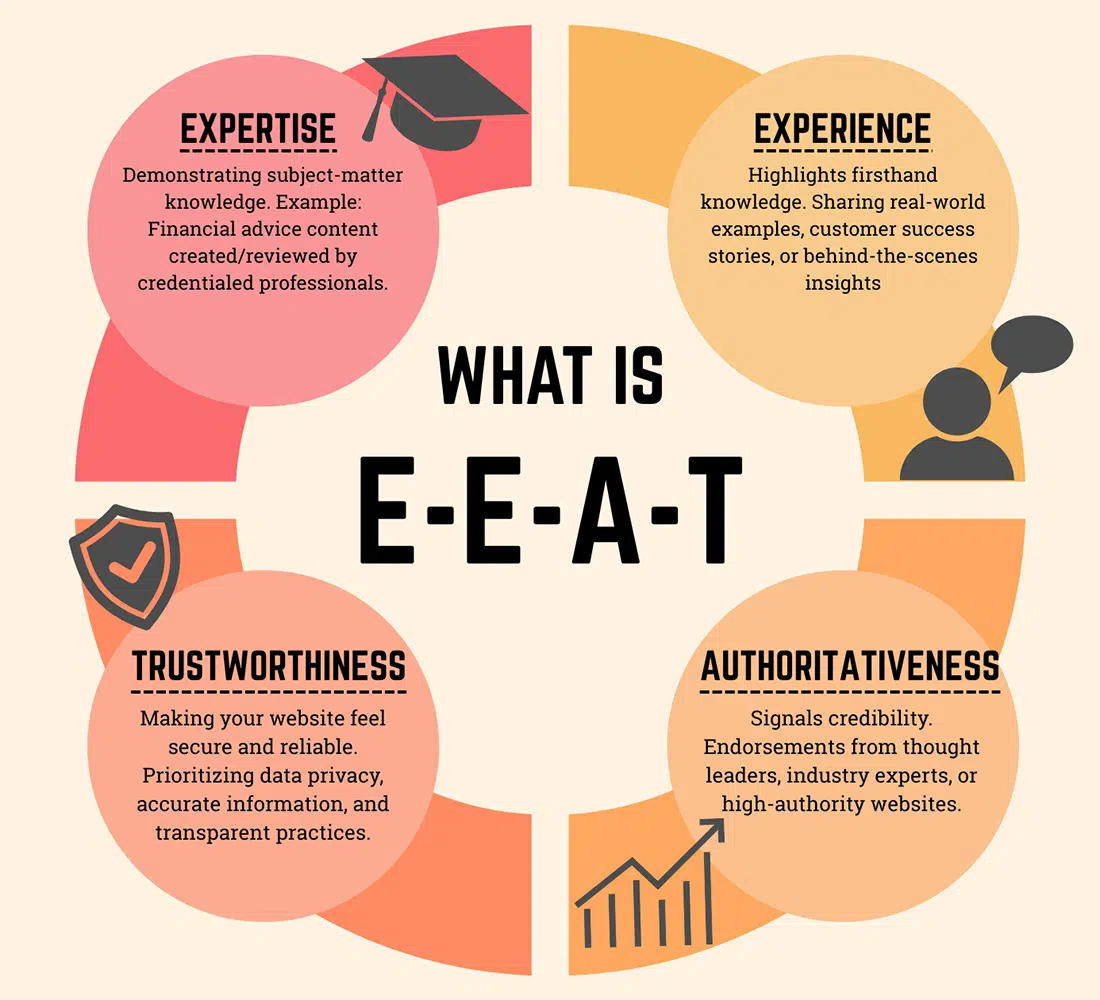
Google doesn’t just rank websites based on keywords—it evaluates the overall credibility of your business using a framework known as E-E-A-T: Experience, Expertise, Authority, and Trust, for example:
- Experience: Have you actually done what you’re talking about?
- Expertise: Do you demonstrate knowledge and skill in your field?
- Authority: Are you recognized as a credible source within your industry?
- Trust: Does your website feel safe, transparent, and legitimate?
Every trust signal on your website contributes to one or more of these factors. The stronger your E-E-A-T signals are, the more likely your site is to rank well—and convert visitors into customers.
Here’s what your website needs to establish trust & authority
1. Verifiable Business Information
Clear, verifiable business details—such as your company name, registration (if applicable), and legal identifiers—are foundational trust signals that demonstrate your business is legitimate, established, and accountable. From an SEO perspective, this supports entity validation, helping Google connect your website to a real-world business. The more consistent and verifiable your information is across your site and the web, the stronger your authority becomes.
But here’s the key:
It’s not enough to simply list your business name—it needs to be verifiable.
Both users and search engines often cross-check business information through external sources such as:
- State business registries (e.g., Wisconsin Department of Financial Institutions)
- Google Business Profile listings
- Professional directories (Chamber of Commerce, industry associations)
- Review platforms like Google Reviews, Yelp, or BBB
- Social media profiles and local citations

If your business appears consistently across these platforms—with matching name, address, and details—it reinforces legitimacy. If information is missing, inconsistent, or difficult to verify, it can create doubt.
Strong verifiable business information may include:
- Your full business name (used consistently everywhere)
- Registered business name (if different from your brand name)
- Business registration details (LLC, Inc., etc., when applicable)
- Years in business or founding date
- Links to your Google Business Profile or relevant directories
Consistency is critical. Even small discrepancies in your business name, address, or contact details across platforms can weaken trust signals and impact local SEO performance. At the end of the day, verifiable business information does more than check a box—it proves that your business exists beyond your website, which is exactly what both users and Google are looking for.
2. Physical Address & Contact Information
A real, verifiable business address and phone number are foundational trust signals that instantly increase credibility.
Google uses this information to validate your business location and connect it to your Google Business Profile, local citations, and map listings. Consistent, accurate contact details across your website and the web help reinforce your legitimacy and improve local search visibility.
For users, this information answers a simple but critical question:
“Is this a real business I can actually reach?”
Remember that not all contact information carries the same weight. Listing a P.O. box, a vague statement like “Located in Madison, WI,” or only providing a mobile number does very little to build trust. In many cases, it can actually raise red flags. Users are increasingly cautious, and if they can’t clearly identify where your business operates or how to contact you, they’re more likely to leave and look elsewhere.
A strong contact section should include:
- A physical business address (when applicable)
- A local phone number
- A clearly accessible contact page
- Consistent business information across all platforms
Even if you operate from home or don’t have a storefront, transparency still matters. Clearly communicating your service area, response methods, and availability helps establish trust and removes uncertainty.
The clearer, more consistent, and more verifiable your contact information is, the more confident both users and search engines will feel about your business.
3. Reviews, Testimonials & Case Studies
Verified Reviews are one of the strongest trust signals you can have.
Reviews and testimonials provide social proof, while case studies demonstrate real-world results. From an SEO standpoint, they contribute to:
- Increased time on page
- Higher conversion rates
- Potential rich results (with proper schema)
The more specific and detailed your proof is, the stronger your authority becomes.
4. High-Quality, Error-Free Content
Content quality is one of the most overlooked—but most influential—authority signals on your website.
Poor grammar, spelling mistakes, or awkward, unclear writing immediately create doubt. Visitors may not consciously analyze it, but they feel it—and often equate low-quality content with low-quality service. In many cases, they’ll leave your site without taking action.
From an SEO standpoint, Google evaluates content through the lens of Experience, Expertise, Authority, and Trust (E-E-A-T). Well-written, accurate, and clearly structured content signals that you know what you’re talking about. It demonstrates expertise and reinforces your authority within your industry.
High-quality content should:
- Be clear, concise, and easy to read
- Answer user questions directly and thoroughly
- Be free of spelling and grammatical errors
- Use natural, well-integrated keywords (not forced or stuffed)
- Be structured with headings, spacing, and logical flow
In addition, strong content keeps users engaged—leading to longer time on page, lower bounce rates, and better overall engagement metrics, all of which support higher rankings. At the end of the day, your website content isn’t just informing—it’s representing your business. If it feels rushed, unclear, or unpolished, users will assume your services are too.
5. Professional Website Design & User Experience
Website design is far more than visual appeal—it’s a critical trust signal that directly influences how both users and search engines evaluate your business.
Within seconds of landing on your site, visitors are making judgments about your credibility. A dated, cluttered, or poorly structured website creates immediate doubt, while a clean, modern design signals professionalism, stability, and attention to detail. In many cases, design alone determines whether a user stays or leaves.
From an SEO perspective, Google closely monitors user experience and engagement signals. If users quickly bounce, struggle to find information, or abandon your site, it sends a clear message that your website is not meeting expectations.
A strong, high-performing website should include:
- Fast load times (Core Web Vitals performance with Google Pagespeed Insights): Speed is a confirmed ranking factor. Slow sites increase bounce rates and reduce conversions.
- Mobile responsiveness: Most users are on mobile devices, and Google uses mobile-first indexing. Your site must function seamlessly across all screen sizes.
- Clear, intuitive navigation: Users should be able to find what they need quickly and easily without confusion or excessive clicking.
- Readable typography: Clean fonts, proper sizing, and good contrast improve readability and keep users engaged.
- Clean, organized layout: Well-structured pages with clear hierarchy, spacing, and visual flow make content easier to scan and digest.
Beyond these fundamentals, strong design also builds trust through consistency—aligned branding, cohesive visuals, and thoughtful use of imagery all contribute to a polished, professional experience.
Ultimately, design impacts how users interact with your site. The easier and more enjoyable that experience is, the longer they stay, the more they engage, and the more likely they are to convert—sending powerful positive signals back to Google.
6. Strategic “About” & “Meet the Team” Pages
People don’t trust faceless businesses—they trust people. And your About and Meet the Team pages are where that trust is built.
These pages are often among the most visited on a website because users want to know who they’re working with before they take the next step. If this information is missing, vague, or generic, it creates hesitation and can cost you conversions.
From an SEO perspective, these pages play a key role in demonstrating Experience, Expertise, Authority, and Trust (E-E-A-T). Google looks for clear signals that real people are behind your business—especially for service-based, local, and professional industries.
A strong About or Team page should clearly communicate:
- Who you are: The real people behind the business—not just a company name
- Your background and experience: Years in business, specialties, and industry knowledge
- Why you’re qualified: Certifications, training, notable projects, or unique expertise
- Proof of your experience: Real examples of your work, case studies, results, or client success stories that demonstrate what you’ve actually done
- Your story and mission: What sets your business apart and why you do what you do
Adding real photos (not stock images), names, and even personality-driven details helps humanize your brand and build rapport. The more authentic and transparent you are, the more comfortable users feel moving forward.
These pages also support SEO by strengthening your site’s overall credibility and helping Google connect your business to real-world entities. When combined with consistent branding, reviews, and external mentions, they reinforce your authority across the web.
For many businesses, especially local and service-based ones, this isn’t just a “nice-to-have” page—it’s often the deciding factor between a user choosing you or moving on to a competitor.
7. Certifications, Awards & Accreditations
Industry recognition validates your authority.
Certifications and affiliations act as third-party endorsements, signaling to both users and search engines that your business meets recognized standards. These are especially powerful in competitive or regulated industries.
8. Consistently Updated Content
An active, consistently updated website signals that your business is current, engaged, and relevant—both to users and to search engines.
Google favors websites that are actively maintained because fresh content indicates that the information is more likely to be accurate, useful, and aligned with current search intent. A stagnant website, on the other hand, can appear outdated or neglected, which can negatively impact both rankings and user trust.
Regular updates don’t just mean publishing blog posts—they include:
- Adding new content, such as blogs, case studies, or project highlights
- Updating existing service pages with improved copy, new keywords, or expanded information
- Refreshing outdated statistics, images, or references
- Showcasing recent work, testimonials, or client results
From an SEO standpoint, consistent updates:
- Encourage more frequent crawling and indexing by Google
- Create additional opportunities to target relevant keywords
- Improve internal linking and site structure
- Increase user engagement with new, valuable content
Equally important is maintaining the quality of your existing content. Pages that contain outdated information, expired offers, or old copyright dates can quickly erode credibility. Users may question whether your business is still active, and Google may deprioritize content that no longer aligns with current relevance.
A well-maintained website shows that your business is not only active, but invested in providing accurate, up-to-date information—strengthening both your authority and your ability to rank.
9. Secure Website (HTTPS)
Security is one of the most basic—but most critical—trust signals. Your website should be secured with an SSL certificate so that your URL begins with https instead of http. That small padlock icon in the browser signals to users that their data is protected.
From an SEO perspective, HTTPS is a confirmed ranking factor. Google prioritizes secure websites because they provide a safer user experience. If your site is flagged as “Not Secure,” users are far more likely to leave immediately—impacting bounce rate, engagement, and ultimately your rankings.

A visual representation of the importance of an SSL certificate and how it looks in browsers when you do not have an SSL, it is a http vs. https representation
Beyond rankings, security also protects form submissions, login data, and any sensitive information exchanged on your site. Without it, both users and search engines will question your credibility.
10. Clear Payment & Transaction Information
If your website involves any type of transaction—whether it’s e-commerce, deposits, or service payments—clarity is everything.
Users need to feel confident that their payment is secure, legitimate, and processed through a trusted system. Clearly displaying accepted payment methods (Visa, Mastercard, PayPal, etc.), secure checkout messaging, and recognizable payment icons can significantly increase conversion rates.
From a trust standpoint, uncertainty kills conversions. If users hesitate or question the process, they leave.
From an SEO perspective, clear transactional structure and user flow improve engagement metrics and reduce abandonment rates—both of which signal a high-quality site to Google.
11. Transparent Policies (Shipping, Returns, Terms)
Transparency removes friction—and friction kills conversions.
Clear, easy-to-find policies for shipping, returns, cancellations, and terms of service show that your business is legitimate and accountable. Users want to know exactly what happens after they click “buy” or submit a form.
Search engines also favor sites that demonstrate completeness and transparency. Well-structured policy pages contribute to overall site quality and trustworthiness, especially for e-commerce and service-based businesses.
Strong policy pages should:
- Be easy to find (footer navigation is standard)
- Be clearly written and specific
- Set realistic expectations (delivery times, return windows, etc.)
The more upfront you are, the more confident users feel.
12. Active Social Media Presence
Your brand doesn’t exist in a vacuum—Google evaluates your presence across the web.
Active, well-maintained social media profiles reinforce your legitimacy and authority. When users discover your business, they often check your social platforms to validate what they see on your website.
A strong social presence signals:
- Your business is active and current
- You engage with your audience
- Others are interacting with your brand
From an SEO standpoint, social signals indirectly support your authority by driving traffic, increasing brand visibility, and creating additional pathways for users to discover your content.
However, consistency matters. An inactive profile with outdated posts can actually hurt trust more than not having one at all.
13. Privacy Policy & Legal Pages
These may not be exciting—but they are essential.
Privacy policies, terms of service, and disclaimers are foundational trust signals that show your business operates transparently and complies with legal standards. For many types of websites, especially those collecting user data, these pages are not optional.
Google expects legitimate websites to include this information. Missing legal pages can be a red flag, particularly for sites handling personal data, payments, or lead generation forms.
Additionally, these pages reinforce professionalism. A complete website with proper legal documentation signals that your business is established, credible, and trustworthy.
14. Industry Involvement & Mentions
Authority is often built outside your own website.
If your business has been featured in industry publications, participated in events, spoken at conferences, or collaborated with recognized organizations, those signals should be highlighted on your site.
These types of mentions do two important things:
- They build credibility with users by showing third-party recognition
- They often generate high-quality backlinks, which are a major ranking factor
Google places significant weight on external validation. The more your business is referenced by authoritative sources, the stronger your perceived expertise and authority become.
15. Community Involvement & Brand Values
Trust isn’t just built on credentials—it’s built on connection.
Showcasing community involvement, charitable work, or local partnerships humanizes your brand and builds deeper trust with your audience.
Users are more likely to engage with businesses that feel authentic, relatable, and invested in something beyond just selling a product or service.
From a branding and SEO perspective, this type of content:
- Builds emotional connection
- Encourages sharing and engagement
- Strengthens your local presence
It’s not just about what you do—it’s about what you stand for.
16. High-Quality Backlinks
Backlinks remain one of the strongest authority signals in SEO.
When reputable, relevant websites link to your site, it acts as a vote of confidence in your content and business. Google uses these links to evaluate your authority within your industry. However, not all backlinks are equal (read my blog post on toxic backlinks for more info).
High-quality backlinks should be:
- From authoritative, trusted domains
- Relevant to your industry or services
- Naturally earned through content, partnerships, or mentions
Low-quality or spammy backlinks can actually harm your rankings, so it’s important to focus on quality over quantity. A strong backlink profile tells Google that your website is respected, referenced, and worth ranking.
17. Click-Through Rates (CTR)
Your search result listing is your first impression—and users decide quickly.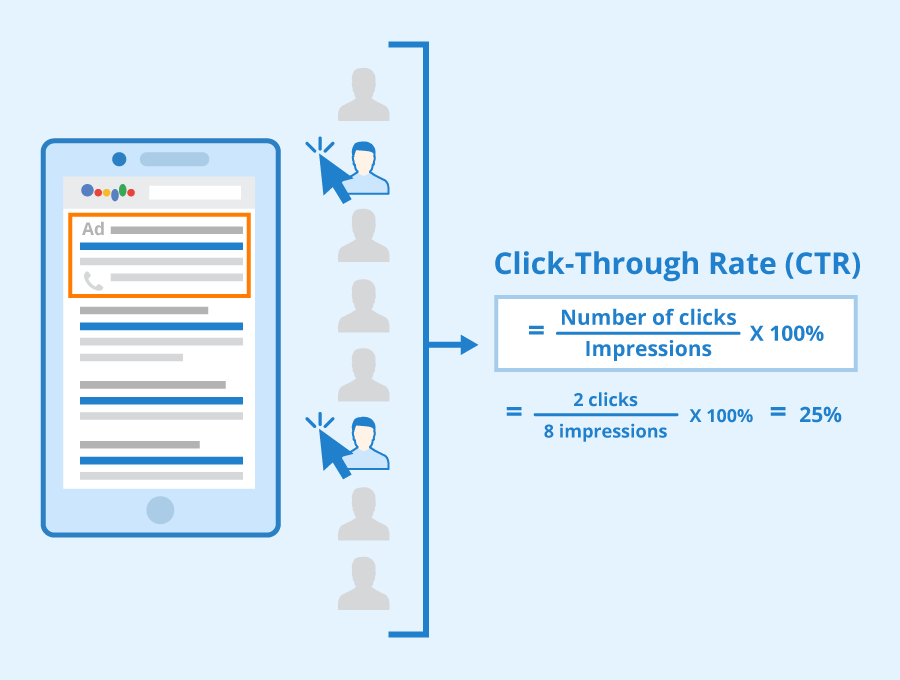
Click-through rate (CTR) measures how often users click on your website after seeing it in search results. A higher CTR signals to Google that your listing is relevant and appealing for that query.
Optimizing your title tags and meta descriptions is key. They should:
- Clearly communicate what the page offers
- Include relevant keywords naturally
- Be compelling enough to stand out from competitors
If users consistently choose your site over others, Google interprets that as a strong indicator of relevance and trust—potentially improving your rankings over time.
18. User Engagement & Time on Site
What happens after a user lands on your site matters just as much as getting them there.
Google tracks engagement signals such as:
- Time on page
- Pages per session
- Bounce rate
These metrics help determine whether your content is actually valuable to users. If visitors leave quickly, it signals that your site didn’t meet expectations.
Strong engagement, on the other hand, indicates:
- High-quality, relevant content
- Good user experience
- Clear navigation and structure
To improve engagement, focus on:
- Clear, scannable content
- Internal linking to guide users
- Strong visuals and layout
- Fast load times
The longer users stay and interact, the stronger your authority becomes in the eyes of both users and search engines.
Final Thoughts
Authority isn’t built from one thing—it’s the result of everything working together.
- You can have great content, but without trust signals, it won’t convert.
- You can have a beautiful site, but without authority, it won’t rank.
Is Your Website Missing Critical Trust Signals?
If your site isn’t ranking—or isn’t converting—it’s not random. There’s always a reason.
Most businesses are missing key authority signals that Google looks for and that users expect. And without them, your website will continue to underperform—no matter how much content you add.
If your rankings have stalled or your site isn’t converting the way it should, it’s time to look more deeply, and I can help you fix it.
I offer a comprehensive website audit that identifies:
- SEO issues that are holding your rankings back
- Missing trust and authority signals
- User experience problems that are hurting conversions
- Clear, actionable steps to improve performance
Request a Website Audit and get a clear roadmap for improving your rankings and conversions.
Frequently asked questions on trust and authority signals
What are trust signals on a website?
Trust signals are elements on your website that demonstrate credibility, legitimacy, and reliability to both users and search engines. These include customer reviews, testimonials, secure HTTPS connections, clear contact information, professional design, and authoritative backlinks. Strong trust signals help users feel confident in your business and increase the likelihood of conversions.
Why are trust signals important for SEO?
Trust signals play a critical role in how Google evaluates your website. They support E-E-A-T (Experience, Expertise, Authority, and Trust), which is a major factor in search rankings. Websites with strong trust signals tend to have better user engagement, lower bounce rates, and higher credibility—leading to improved visibility in search results.
How do I know if my website is missing trust signals?
What are the most important trust signals for a website?
What is E-E-A-T and why does it matter?
E-E-A-T stands for Experience, Expertise, Authority, and Trust. It is a framework Google uses to evaluate the quality and credibility of content. Websites that clearly demonstrate these qualities—through strong content, real-world experience, and trustworthy signals—are more likely to rank higher in search results.
Do backlinks still matter for SEO?
Yes, backlinks remain one of the most powerful ranking factors in SEO. When reputable and relevant websites link to your content, it signals to Google that your site is trustworthy and authoritative. The quality of backlinks is far more important than quantity, so earning links from respected sources is key.